Category Archives: Blog

7 of the Most Popular Autoclave Questions


We answer the top questions being asked about autoclaves and the sterilization process.


At Beta Star, our mission is to provide simple and reliable sterilization solutions. Delivering sterilization simply begins with a consistent understanding of steam sterilization solutions through the use of autoclaves, also called steam sterilizers. In preparing for this article, our team dove into Google’s online search results to identify seven of the most frequently asked questions related to autoclaves and the sterilization process they execute. 

1) Why is the standard autoclave temperature set to 121oC?

Sterilization of media, the centric purpose of autoclaves, is designed to reduce the presence of live pathogens that could contaminate the development of pharmaceutical drugs, invalidate the results of research institutions, or allow outside pathogens into vivarium laboratories.

The death of the pathogen, whatever type it may be, is completed by the destruction of the structural and metabolic cell components required for replication. Without the ability to replicate or infect, the pathogen is no longer a threat to the environment around it. While specific pathogens or specific environments may require higher temperatures, 121oC is widely held as the minimum temperature for efficient sterilization. 121oC is necessary, because at 100oC (the boiling point of water under unadulterated atmospheric conditions) endospores are not killed and thus sterilization cannot be fully achieved. In fact, Geobacillus stearothermophilus is used as an indicator to confirm that a successful sterilization cycle was completed. This answer is further vetted in conjunction with question number five.

2) Why are autoclaves being used for media preparation?

Autoclaves are used to prepare many different types of media for their final purpose. They are used to provide sterile media that may be consumed in different applications, such as in vivarium laboratories and food & beverage manufacturing. Media is also studied in microbiology laboratories, tested in innovative research institutions, and distributed for life-saving applications like pharmaceutical medicine or orthopedic facilities. The most important aspect of the autoclaves that deliver sterilization, are their ability to give a biological blank slate to the user. From this blank slate:

  • Media (water, food, etc.) may be consumed safely without contaminants
  • Studies may be completed without the altering presence of an unknown or uncontrolled pathogen
  • Research tests can be completed and replicated, thus ensuring adoption and acceptance of the test results
  • Providing life-saving applications, such as orthopedic devices or COVID-19 testing kits, that are packaged free from pathogens

3) Who invented the autoclave?

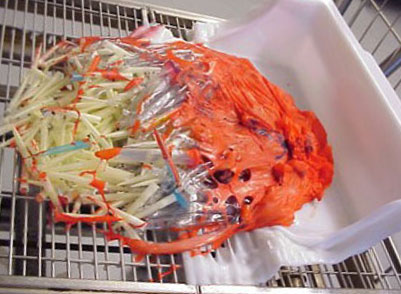
The first autoclave-like pressurized vessel, similar to what is now known as a pressure cooker, was built by Denis Papin in 1679! However, it would take another 200 years before the autoclave as we know it would be built. In 1879, Charles Chamberland, working Louis Pasteur (the inventor of the pasteurization process) created the first autoclave for medical and scientific purposes. Want to see a cool photo of a 115-year-old autoclave? Check out the photo of an autoclave built in 1905 by Northwestern Steel and Iron Works.

4) What are autoclave bags used for?

Autoclave bags are used to hold biohazardous items until it is time to be sterilized in an autoclave. The high-density propylene that they are typically made of can withstand temperatures up to 135oC, the high end of nearly all autoclave cycle parameters.  When searching for autoclave bags to use at your facility, it is recommended that the manufacturer of those bags meet the following regulations:

5) How does autoclave sterilization work?

Sterilization in an autoclave (often aptly referred to as a steam sterilizer) works through the manipulation of four aspects vital to effective sterilization: time, temperature, pressure, and steam. They all play an important role in the process of effective sterilization:

  • Time: Proper time ensures that the pathogens have been in the presence of a sterilizing environment (steam at temperature) for a long enough time to facilitate the proper killing of all pathogens.
  • Temperature: Proper temperature of the steam that comes in contact with all pathogens, a minimum of 121°C, ensures the proper destruction of the pathogen’s ability to reproduce.
  • Pressure: Manipulating the pressure in an autoclave’s prevacuum cycle ensures that no air pockets are left remaining in the sterilizing chamber. Air pockets provide insulation to pathogens from the sterilizing environment and are removed during pressure ramping so that the pathogens do not escape proper sterilization.
  • Steam: Transfer of heat is most efficiently done using steam. The steam fills the chamber so that it can come in contact with the entirety of the sterilization load.

6) What are autoclaves used for?

At a foundational level, autoclaves are used to execute the steam sterilization process. They are designed to kill 99.9999% of all pathogens after a successful sterilization cycle is run. This is commonly referred to as a 6-log reduction in living pathogens. For the respective industries that we operate in, autoclaves are commonly used for:

  • Biomedical / Pharmaceutical: In these laboratories, autoclaves are frequently used for the research development of drugs and vaccines.
  • Common Laboratory (Research): in these laboratories, research tools and instruments are the most frequently autoclaved items.
  • Vivarium: to maximize throughput, bulk autoclaves are used in vivarium facilities to sterilize cages and bedding for the protection of research subjects.

7) Can autoclaves kill viruses?

Autoclaves are capable of killing all types of pathogens, including viruses through the effective use of the four tools for sterilization mentioned in the answer to question 5. This has become especially poignant as the world grapples with the COVID-19 pandemic. Killing viruses are important in some applications for sterilizing medical tools and PPE before they are discarded.


Sources

(Question 1) Science Direct
(Question 1) National Center for Biotechnology Information (NIH)
(Question 3) Smithsonian Institute
(Question 4) Tufpak
(Question 5) CDC


Welcoming a New Leader

Beta Star promotes Kevin Robb, multi-faceted manufacturing and sales expert, to market area manager.

Honey Brook, PA – Effective Monday, February 3rd, Beta Star Life Science Equipment is under new leadership. Kevin Robb, multi-faceted manufacturing and sales expert, accepted a promotion to bring his manufacturing efficiency and creative sale solution experience to the Beta Star team. Under Robb’s leadership, the group will push to spread the promise of Simple. Reliable. Sterilization.™ to biotechnology, general research, pharmaceutical, and vivarium facilities across North America.

The transition happened swiftly as Robb’s experience with Beta Star owner R-V Industries made it a seamless transition to the role of Market Area Manager for Beta Star.  In his latest role as Plant Manager with R-V, Robb led the manufacturing operations of the Honey Brook headquarters which included the oversight of the manufacturing of all Beta Star autoclaves. Before that role, Robb was a sales development professional in the custom fabrication division of R-V, where he created unique solutions to complex spacing and process efficiency issues for industrial process customers.

Kevin Robb, new market area manager of Beta Star

For customers, the rest of the Beta Star team will remain unchanged. For sales needs, Bill Purvis and Lynn Johnson will remain sales managers of the Eastern and Western portions of the USA. For service needs, the department will remain under the leadership of Todd Houck. The addition of Robb represents R-V’s continued commitment to the success of Beta Star by bolstering the resources and manufacturing knowledge available to customers. Robb is replacing Kevin Putt, VP of Sales for R-V, who was also serving as interim market area manager of Beta Star.

“I’m excited to take on the leadership of the Beta Star Life
Science Equipment market area,” said Robb. Being able to work to improve sales development and manufacturing processes while effectively pairing our team’s skills with customer-serving initiatives helped make this opportunity so enticing. I look forward to seeing our team grow while helping to advance people forward in their respective careers.”

For Beta Star customers, Robb plans to take a two-pronged approach
to providing the industry with a reliable, cost effective, and world class
solution to fill sterilization needs. “Building a nationwide network of sales reps to come alongside our existing reps, while cutting manufacturing and sales turnaround lead times will help Beta Star continue to grow its reach as a sterilization equipment and service provider,” added Robb.

Beta Star is a unique solution in the sterilization industry, as 38 years of experience as an autoclave manufacturer and service provider partners with R-V Industries 260 employees to form a dependable partnership for biotechs, research firms, and pharmaceutical companies.

Beta Star serves as a proudly American autoclave manufacturer and service provider based out of Honey Brook, PA. All sterilization equipment is built with serviceability in mind, as Beta Star was founded in 1982 as a steam sterilizer service provider. Today, Beta Star services hundreds of customers around the world in the biomedical, university, and vivarium sectors by simply and reliable creating sterilization solutions.  

For more information, or to connect with Kevin, visit Kevin and follow Beta Star on LinkedIn.

Custom Autoclave Integration Solutions

Unique Customer Problem: Unnecessary Utility Consumption

For a recent customer, we supplied an equipment package of 11 autoclaves, varying in sizes from 20” x 20” chambers to bulk chambers, for a new state-of-the-art vivarium laboratory at a renowned medical school in the South Central US. The Beta Star team, with it’s raw plate to FAT approach, completed the design and manufacture at it’s company headquarters. Using company monitored warehouse space, Beta Star was able to store the sterilizers until the new building was completed.

autoclave control system integration
Autoclave Control System Integrations

After sterilizer installation and user training was completed, an issue which drove a significant increase in heat loss to room. In the bulk autoclave room, a vent fan was installed to pull out the heat released to the room once the sterilizer door is opened upon cycle completion. As designed, this step was a manual process that had to be written into the customer’s Standard Operating Procedures and executed by the laboratory technician. Not only was this process dependent upon manual execution after cycle completion and door unseal, it required that all cycles be completed during working hours to effectively mitigate heat loss to room. In addition, it frequently became a missed step for the laboratory technicians, who were rightly focused on conducting and monitoring their research.

The Beta Star Solution: Building Management System (BMS) Integration

From the outset of problem discovery, the customer and Beta Star’s Controls Engineering Team goal was to automate the fan operation to reduce utility consumption generated by the sterilizer’s heat loss to room. The custom developed plan, spearheaded by the Controls Team, created a connection between the new facility’s Honeywell Building Management System (BMS) and the Allen Bradley PLCs that power all Beta Star sterilizers. Through this connection, the exhaust fan system in the bulk sterilizer rooms would start upon door release and operate for 15 minutes. All of the parameters, such as fan initiation and operation time, were customized to suit the customer’s desires, and are programmable through their in-house BMS.

Are you experience problems with sterilization facility processes? Looking for a way to automate process steps to free up your technicians to focus on the search? Get in touch with Beta Star for a review of your existing problems.