Category Archives: Blog

Team-Centric Spotlight to Sterilizer Production

The Power of a Team

The power of a team, working in tandem with each other, is how great accomplishments in sport and in manufacturing are achieved. In sport, the head coach of Duke Men’s Basketball Team, Mike Kryzyzewski, has led one of the most successful college basketball programs of all time. In fact, under his leadership, the Duke Team has won the 4th most NCAA Basketball Championships of all time! During that time, he has coached many remarkably talented individuals who went on to become recognized worldwide for their individual success.

However, his coaching mantra of the importance of the power of team over the capability of self is summarized by one of his most infamous quotes. In an Inc.com article highlighting a quote from his book Leading with the Heart, Kryzyzewski stated, “I look at the members of our team like the five fingers of a hand. Individually, the fingers aren’t as powerful as all of them coming together into a fist.â€

While the 5-finger analogy functions perfectly for a basketball team with five men on the court at one time, the truth behind the wisdom of the statement is something reflected in the team approach to producing any type of manufactured equipment. For the Beta Star team, to the ability to functionally produce a quality sterilizer is found in the interconnectedness of our manufacturing process.

“I look at the members of our team like the five fingers of a hand. Individually, the fingers aren’t as powerful as all of them coming together into a fist.”

Coach Mike Kryzyzewski

For a recent project providing seven different sterilizers to a customer producing pharmaceutical grade solutions for the research industry, the Beta Star division, support by parent company R-V Industries, successfully leveraged the breadth of our resources to satisfy our customer’s unique sterilization demands. This interconnectedness was essential to maximize the production process as, on one’s one, a project that would have taken over half a year to manufacture, assemble, and ship, was scheduled to be completed in 2 months of manufacturing time. Take a look inside our “Raw Plate to FAT†Sterilizer Production Process on a recent project with seven different sterilizers:

Engineering and Design

Though many of our customers select sterilizer models from industry standard lines, the Beta Star production process begins with the engineering department. For this particular project, documented engineering control and justification for machine design is a vital step in the process of creating seven sterilizers that will adhere to the guidelines that pharmaceutical customers are held to. For more on those guidelines, visit our post about the pharmaceutical machine guidelines.

At this stage, a Bill of Materials is established for every component used in the manufacturing of the sterilizer machine and a completed Piping and Instrumentation Drawing (P&ID) is created for customer sign-off to ensure the marriage of machine design and customer expectations.

INVENTORY MANAGEMENT TEAM

As a manufacturer and service provider, Beta Star keeps significant inventory levels to manage high demand production times, and overnight shipping service and parts needs. The production process, for a run of numerous sterilizers such as the project mentioned above, starts with our non-proprietary components, which ensure cost efficient part replacements throughout the life of the sterilizer. For this project, members of the inventory control team pulls and delivers all parts from the Bill of Materials generated form engineering, to the proper production team members to keep the manufacturing and assembly process as efficiently as possible.

PRODUCTION PLANNING AND MATERIAL MANAGEMENT

Production Planning and Material Management teams take over the next stage in the Plate to FAT production process. At this stage, the fabrication schedule is carefully planned out for the following weeks and months to ensure on-time delivery. To prevent the collateral damage of delays in any stage of the production process, a team meeting establishes department level deadlines where individual accountability is accepted.

PLATE BURNING AND BENDING

At this stage, the raw plate to FAT process officially begins. The first step is to take the raw plate, consisting of 316 and 304 stainless steel, and use our highly specified table burner to cut pieces for the formation of the sterilization chamber, jacket, and doors.

After the pieces are cut, the plate bending team utilizes our in-house bending machinery to form the pieces previously cut to match the specification drawings. At this stage the pieces begin to take shape and resemble the sterilization chamber, jacket, and doors seen at the finished product. To bend stainless steel, at a common dimension of ½ an inch, the bending machines must use a minimum of 87.89 tons of pressure to create the angles to build the sterilizer essentials (chamber, jacket, and doors).  

PRE-FABRICATION AND WELDING

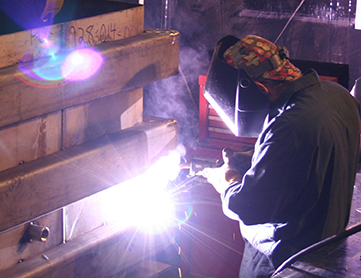
The next step in the process is the pre-fabrication of the sterilizer essentials. To protect the material integrity from cross contamination with non-stainless-steel material, all pre-fabrication and welding tasks are completed in our 26,000 square foot stainless and alloy only facility. Protecting stainless steel material from cross contamination is important to protecting the lifespan of the sterilizer, as any contaminants from carbon steel grades can cause rusting and degradation of the chamber and door surfaces.

At the pre-fabrication step, skilled employees fit the previously cut and bent pieces together and tack weld those pieces to each other to hold the pieces in properly alignment and positioning. After pieces of the sterilizer are tack welded, final welding is completed utilizing our vast array of over 300 certified weld procedures for all types of material including 304 stainless steel, 316 stainless steel, and 2205 duplex stainless steel.  To ensure the quality of these welds, our sterilization chambers will be hydro-tested to spot any structural deficiencies in the finished product.

MECHANICAL AND ELECTRICAL ASSEMBLY

The final and critical step of the sterilizer production process before shipment is the mechanical and electrical assembly. The mechanical assembly team completely fits out a raw chamber with the piping and valve systems to create a fully functioning sterilizer. However, to get the sterilizer to function, it requires the electrical assembly and controls engineering teams to engineer and connect the PLC and HMI to power the sterilizer. Through dozens of hours, these two assembly teams create a functional sterilizer that is ready for Factory Acceptance Testing before it moves to the final stage of the process.

SHIPPING AND LOGISTICS

Bolstered by the support of an in-house fleet of logistics, trucking, and packaging professionals, we are able to ensure that our sterilizers are properly packaged and delivered to the proper facility at the right time. To facilitate unexpected delays in new construction and renovation projects, we offer climate controlled warehouse storage as an option to keep customer workplaces free of the barriers of large sterilizers.

THE POWER OF TEAM

Through the vastness of all of our different engineering and production departments, a variety of different skills sets, mastered through years of years of experience, are brought together to create a batch of seven sterilizers for our customer. The professional level of experience is proven out by the fact that the average current employee at R-V Industries, parent company of Beta Star, is over 10 years. And together, this team bears proof that the quote of legendary Coach Mike Kryzyzewski is true.

Sterilization For EN 285, 21 CFR, and cGMP Requirements

For years, Beta Star has been providing high-level pharmaceutical steam sterilizing autoclaves to pharmaceutical facilities. Having a reliable provider of sterilization equipment for these types of laboratories, with the documentation to back it up, is paramount to the success of our customers’ applications for new drugs, processing of drugs, and proper sterilization of finished drugs before distribution. Our current customers in these environments have trusted Beta Star to provide the necessary documentation to meet stringent requirements including the European guidelines defined in EN 285:2015, Title 21 of the FDA’s Code of Federal Regulations (CFR), and adherence to cGMP guidelines.

Sterilization and EN 285:2015

EN 285 is required for companies and organizations that are currently exporting or plan to export sterile products to the European Union (EU). Though developed in Britain, these guidelines govern sterilization requirements across the EU, specifically related to the quality of the steam being utilized in the steam sterilization of critical equipment and pharmaceutical drugs. In steam sterilization, the absence of non-condensable material (air or other non-sterilants) is vital to ensure complete load sterility as non-condensable material insulates pathogens from sterilization environments. Measuring the quality and thoroughness of steam penetration is carefully conducted, when required, in Beta Star sterilizers through a series of equipment upgrades:

  • EN 285 steam test elbow and ports
  • Air detector port, metering device, and alarm
  • Air detector load probe
  • 0.19 psia vacuum stabilization hold alarm
  • And many more

In addition, EN 285 specifies several tests to ensure sterilization for a few laboratory-specific scenarios:

  • Steam dryness
  • Steam superheat degree
  • Steam contamination
  • Hollow load test for long tubes or pipettes
  • Pressure fluctuation min/max thresholds
  • Heat penetration of stacked, condensed material

Title 21 CFR Part 211

Title 21 of the US Food and Drug Administration’s Code of Federal Regulations (CFR) establishes a series of Parts that set the regulatory guidelines for sterilization requirements for pharmaceutical companies at various stages of the drug development and distribution processes. Depending upon your organization’s position in the pharmaceutical industry, you may be required to have sterilization equipment that adheres to the following Parts: 21 CFR Part 211: relates to the guidelines required for finished pharmaceuticals. This Part is often most applicable to Beta Star’s customers, summarized by the FDA below. Though, it is important to note that it is applicable to all equipment, including steam sterilizers.

  • Equipment shall be constructed so that surfaces that contact components, in-process materials, or drug products shall not be reactive, additive, or absorptive so as to alter the safety, identity, strength, quality, or purity of the drug product beyond the official or other established requirements.
  • Any substances required for [machine] operation, such as lubricants or coolants, shall not come into contact with components, drug product containers, closures, in-process materials, or drug products so as to alter the safety, identity, strength, quality, or purity of the drug product beyond the official or other established requirements.
    • Source: FDA website

Through a carefully managed engineering and design process, supported by nearly 40 years of experience in the sterilization industry, Beta Star’s design and manufacturing modifications for pharmaceutical sterilizers ensure that your company’s sterilization processes will be compliant with 21 CFR Part 211.

cGMP Sterilizer Design and Manufacturing

cGMP Certifiable Sterilization

Beta Star works with our customers to provide manufacturing excellence and documentation to facilitate the FDA inspections required to achieve complete cGMP certification for the pharmaceutical manufacturing process. For the drug production process, the most important aspect of the proper cGMP machine design is the design process. Previously mentioned documentation is vital in demonstrating that the machine’s engineering process followed a methodical approach to ensure accurate, repeatable, reliable, and safe control of pharmaceutical equipment which process (sterilize) potentially dangerous media. Incorporating machine redundancies provides coverage for component failure, an important design feature of the Beta Star cGMP sterilizer design.

What Makes Sterilization Equipment cGMP Certifiable

  • Finer mechanical or chemical polishing of process contact surfaces (namely the sterilizer chamber and door(s) surfaces.
  • Upgraded instrumentation with industry-leading temperature and pressure control.
  • Multiple pressure and temperature monitoring systems provide system redundancy.
  • Sanitary vessel and piping connections.
  • Multiple electronic and/or paper recording of continuous process conditions and cycle results to ensure cycle tracking redundancy.
  • Complete Device History Records (DHRs); including physical and chemical test reports for any process contact material and machine design, machine testing documentation, final commissioning documentation.
  • The utilization of specialty metal alloys at various parts of the sterilizer to enhance corrosion resistance properties of the sterilizer, such as 316 stainless steel jackets and/or 2205 Duplex chambers.
  • Completely validated, customer specified control and cycle customization options.
  • Enhanced turnover packages and documented machine records that follow the industry-standard design process.

Turnover Packages and Documented Machine Records

  • User Requirement Specification (URS): customer provided document that describes the essential features of machine functionality.
  • Functional Requirement Specification (FRS): Beta Star’s official documented response to outline the fulfillment of the URS.
  • Performance Qualification (PQ): the tests done on the sterilizer to verify that all FRS parameters are satisfied. PQs are executed through Factory Acceptance Testing (FAT), Site Acceptance Testing (SAT), or both depending on customer needs. Typically PQ’s are designed to verify the most challenging process or control specifications, usually related to load volume and throughput needs.
  • Installation Qualification (IQ): verifies installation and utility specifications are satisfied to ensure accurate, repeatable sterilization performance.
  • Operational Qualification (OQ): a similar test to PQ that is only performed post IQ. The OQ typically repeats any special PQ challenges from the customer specifications for the protection of redundancy. An additional difference between OQ and PQ is that OQ verifies and records the results of the verification for every control selection.
  • Commissioning: the final step in the cGMP validation process that is satisfied when Beta Star and our customer agree that all customer demanded process requirements are satisfied.

BSL-3 Sterilization

The Process of Effluent Sterilization

Unique equipment design from Beta Star provides additional layer of safety and sterilization of cycle effluent.

For effective sterilization, especially critical in BSL-3 laboratories and facilities, identifying the piping configuration, load configuration, and cycle parameters which minimize condensate generation are vital components of effective sterilization. This is vitally important, as our studies have shown that pooling condensate in the bottom of the chamber acts as an insulant against complete sterilization for any harmful pathogens that have made their way to the chamber drain. In BSL-3 situations, pathogens that have been insulated from complete sterilization present a serious hazard to the safety of our end users, service personnel, and the environment as the infected condensate is allowed down the drain.

While effective piping and load configurations minimize condensate generation during cycle, all steam sterilizers (autoclaves) generate condensate during operation. Beta Star sterilizers monitor and control sterilizer temperature set-point at the chamber exhaust port. The period of time between the exhaust port reaching the sterilization set-point (typically 121°C) and the load achieving that same set-point is known as lag time. Lag time will vary dependent on load type and cycle selection. For all steam sterilizers, condensate generation is greatest during this lag time. When steam contacts the sterilization load, such as carts, bedding, and cages, while the load is at room temperature, it rapidly cools and condenses upon contact with machine and load surfaces.

To study the insulation properties of the pooling condensate, we looked at the temperature differential between the liquid condensate and the sterilization threshold (in this test, that was 121°C). Our tests revealed that this liquid can be as low as 70°C, over 50°C below the industry accepted set point. 

Chamber Drain Injection Effluent Arrangement

To solve this problem, our engineering team was tasked with creating a solution to solve the effluent insulant problem detailed above. This led to the development of the dual steam injection system, one port for the chamber and one port for the chamber drain. With the development of this Chamber Drain Injection Effluent sterilizer arrangement, Beta Star has ensured the greatest possible pathogen lethality by providing direct steam impingement into the condensate pool which all sterilizers product. The direct steam injection port in the chamber drain significantly increases the temperature in the drain effluent.